Monday, 23 May 2016

The End of the Leeds and Liverpool - Monday 23rd May

We made an early start again today as it was a lovely morning and we wanted to be at Newlay Locks when they opened at 8.15 am. As we passed by Fallwood Marina we saw these historic old wooden boats, the bottom picture shows one of the Little Boats which helped at Dunkirk in 1940.a1

We arrived at the locks dead on 8.15 and the C & RT men were already opening up the locks and kindly assisted us down the staircase flight of 3 locks. They told June that over the weekends they can have a lot of trouble from teenagers jumping in the canal and generally making a nuisance of themselves. The water here was very clear and the lockie told us that in the next month or so it would be crystal clear.a2

The canal here is very pretty as it wends its way down the ever narrowing Aire valley and at Forge Staircase locks there are great views over the railway to the other side of the wooded valley. Again a C & RT man kindly helped us down the flight.a3

Bridge 221A is unusual in that it has a second arch well to one side. I am not sure what this would have been used for but on the other side of the bridge was the Kirkstall Brewery now used a apartments. One of the lock gates had become a very  interesting garden.a4

The site of the old Kirkstall Power Station had this lay-bye for unloading boats which is now used as a Marina.

IMG_7475

The approach into Leeds is very nice and you would not know you were in a city until you reach Granary Wharf as the canal is clean and the water clear. A far cry from some other entrances to cities.

IMG_7476

We filled up with water at the point just above Office Lock and next to it is the Tower Works opened in 1864 by TW Harding making steel pins and gauges for the carding and textile industry.The distinctive Grade 11 towers were based on Italianate Renaissance structures and provided dust and smoke extraction for the factory.They were know by their Italian names of  Giotto and Verona Towers.

IMG_7479

In front of the water point below the lock is Granary Wharf and this enormous Rotunda tower of apartments.

IMG_7477

Finally comes River Lock which marks the end of the Leeds and Liverpool Canal which was started in 1770 and completed in 1816 at a cost of £1,200.000 nearly five times the original cost. The warehouse at the side of the lock was constructed as a terminal for the canal and below the lock is the River Aire with one of the water Taxis which will take you to Clarence Dock.a5

Sunday, 22 May 2016

On Towards Leeds–Sunday 22nd May

A lovely sunny morning as we left our mooring in Shipley passing these palms growing next door.a1

This unusually decorated ex lifeboat was moored at Shipley Wharf and a little further out of town was the Shipley Hand Crafted Brewery and shop.a2

We continued on through the Field and Dobson staircase locks and on to Appley Bridge where we had a pump out at the Calder Valley Marina. The chap who did the pump out was telling us that he and his wife had just taken over the Marina Cafe which looked a very nice place. He had been a professional jockey and although out of it for some years still missed the life every day. Appley is a growing village and there were some nice new developments like these below. It is in easy commuting distance to Leeds by train or bus and the countryside just outside the village is stunning especially considering we are now so close to the City.a3

Our mooring for the night was just outside the village of Rodley surrounded by the Aire Valley. Just beyond the trees and on the other side of the river and rail track a new village is being built and yesterday we passed through the new station which will service it .a6

A short walk down the canal took us to the Tiny Tea Rooms for afternoon tea. We were too late for the scones and clotted cream tea as the towpath had been busy all day and they had nearly run out of every thing. However, June and Graham had huge portions of Apple Pie whilst Carolann and I had delicious fruit cake. You do have to sit outside but there is one area which is under cover should it rain. We thought that the lady and gentleman serving the food must live on the Dutch Barge moored next to it as we saw them pop into it a couple of times.a4

I had a stroll around the village which is on a busy road with a couple of pubs and restaurants as well as several hair salons. The top pictureshows one of the nice gardens backing on to the canal and opposite were these delightful little Shetland ponies; even the short grass came up to their stomachs.a5

Exploring down by the river I found this old Packhorse bridge built in 1775 with the cobbled street leading down to it via the Railway Pub and with the cobbles continuing over the bridge.a7

Another Train trip–Saturday 21st May


a8

The forecast for today was rain and more rain but after heavy overnight rain the morning was dry but overcast. We had decide not to move today in view of the forecast and so caught the 10.02 am train to Leeds. The train was late, not arriving until 10.09 because the doors on the third carriage would not open. The guard had to prize them open and move everybody into the two remaining coaches so we had to stand for the 10 minute journey into Leeds. Walking out of the station we were right on to Granary Wharf where there were about 5 vacant mooring places but non of the electric and water points worked. We walked down the river for about half a mile to Clarence Dock where we found plenty of boats moored but the one side is for permanent moorers and the other side only takes a bout 4 visiting boats and was full.

We walked back up into the city and had some lunch and then caught the train back to Shipley getting back to the boat before the rain set in.

Later I went into the town and found the Market Square ( pictured above) with its lacy umbrella and clock tower. The indoor market had some interesting stalls selling all sorts of items.

Friday, 20 May 2016

Bingley 8 Locks and Saltaire - Friday 20th May

We left Riddlesten having moored outside the old Puffer Parts Chandlery now closed after Dougie retired and headed for Bingley. One of the Drum wide beam hire boats had moored on the other side of the swing bridge in a very narrow section of canal and as we negotiated around him and the  trees at a snails pace his stern pin, which had not been hammered home came out and his stern drifted across the canal in front of Autumn Years. After much banging on the hull and tooting of horns the crew finally surfaced from bed and recovered the boat  with many apologies.

The two and a half mile trip to Bingley went without further hitch until we came to the ABC foot bridge which the Nicolsons guide had said was normally lock open. As it happened one of the clubs members had been to get something and left the bridge closed for his return. No problem and he came back just as we went through.

We stopped for water at the Services at the top of the Bingley Five Rise and went to have a chat with the very nice lock keeper on duty. He said that it was fairly quiet at present and he would help us down the flight as soon as we were ready. This flight of 5 staircase locks was opened in 1774 to lower the canal 18 metres (59ft 2 inch) down the Aire Valley over a distance of 320 ft. and is the steepest staircase in Britain. It was designed by John Longbotham and built by local stonemasons. In the distance can be seen the Damart Clothing Mill in Bingley some 90ft lower as the Five Rise is followed quickly by the Three Rise set.

a1

Both sets of locks have gate paddles and the horizontal paddle winders with cow horns to turn them but they are very heavy and the girls struggled with some of them. However the lock keepers came to their rescue. Some of the 5 Rise and all the 3 Rise have these unusual scissor operated gate paddles which again were heavy to wind but were very effective.a2

Several pigeons had decided to nest in the top gates of the 3 Rise locks and flew out as we went down. They did not seem to be bothered by the operation of the locks. Mooring is available on the off side next to the Damart Millto explore Bingley where a new Aldi has recently opened.a3

The Dowley Gap Staircase leaked like a sieve and we had our back decks awash with floods of water as it poured through the gaps and leaky paddles in torrents.

Soon we were entering Saltaire Village with its towering old Mill buildings now converted into apartments. The mooring here does not permit boats to stay over night so we thought we could moor on the armco just passed the buildings but it was so shallow and full of boulders that we could not get closer than 6 ft. to the bank. What a shame it has not been dredged as it would make ideal overnight mooring. Luckily we were able to moor on the Salts Wharf visitor mooring a short way along the canal but there is only room for 2 boats.

a4

After lunch we set off to explore Salts Mill. First I popped into the music shop which has a wide selection of Harps, recorders, guitars and Harpsicords which started at around £8000 each. Entering the old mill building we found on the first floor the 1853 gallery with the worlds largest permanent collection of David Hockney works. The second floor has a wide range of unusual books and one which caught our eye was called “Our Cool Scooter” and brought back memories of our time on our Lambretta. The third floor had another David Hockney collection entitled The Arrival of Spring. The ceiling of the ground floor was of brick in several barrel shaped arches and supported on columns. At the  entrance is this giant size chair again a David Hockney design.
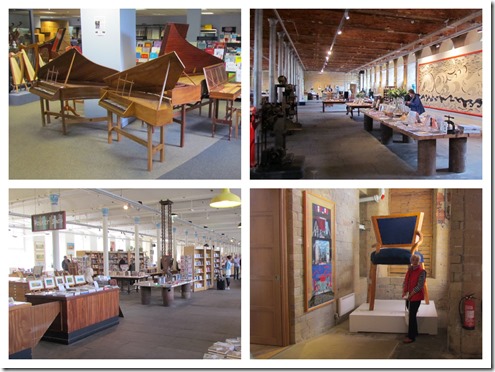
a5

Saltaire was built in 1851 by Sir Titus Salt, a leading industrialist in the Yorkshire woollen industry. The name of the village is a combination of the founder's surname and the name of the river. Salt moved his business (five separate mills) from Bradford to this site near Shipley to arrange his workers and to site his large textile mill by the Leeds and Liverpool Canal and the railway. Salt employed the local architects Francis Lockwood and Richard Mawson. Salts Mill was opened on Sir Titus Salt's 50th birthday, 20 September 1853.

Salt built neat stone houses for his workers (much better than the slums of Bradford), wash-houses with tap water, bath-houses, a hospital and an institute for recreation and education, with a library, a reading room, a concert hall, billiard room, science laboratory and a gymnasium. The village had a school for the children of the workers, alms-houses ,allotments, a park and a boathouse. Recreational initiatives were also encouraged such as the establishment of a drum and fife band for school age boys and a brass band, precursor of today's Hammonds Saltaire Band, for men of the village.

Sir Titus died in 1876 and was interred in the mausoleum adjacent to the Congregational church. When Sir Titus Salt's son, Titus Salt Junior, died, Saltaire was taken over by a partnership which included Sir James Roberts from Haworth.

In December 2001, Saltaire was designated a World Heritage Site by UNESCO.

Below are pictured the Church, Roberts Park, and a couple of the streets with the works houses which are still occupied today as it is a living village.a6

Here are the Village Hall and the Sir Titus Salt Hospital.
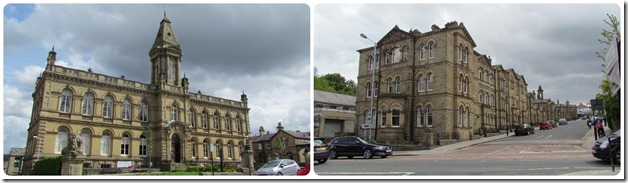
a7

Thursday, 19 May 2016

Bluebell Treat - Thursday 19th May

We made and early start today and there was still low cloud and mist over the hills as we left the back to back houses on the outskirts of Skipton and approached the village of Low Bradley with its ubiquitous Mill Chimney.a1

At Low Snaygill we passed this enormous Hotel Boat moored next to a land hotel.IMG_7353

We spotted two deer chasing one another in a field on the off side. One of them jumped into the gardens of a house whilst the other ran down the field towards us and I managed to get these photographs before he was away up the hill.a2

Sited next to a swing bridge is a memorial to Polish airmen who lost their lives here whilst flying a Vickers Wellington XI on the 23rd September 1943. A little further on, on the towpath is a cross and flowers to the same airmen.

IMG_7358

The canal clings to the high side of the Aire Valley wending its way through lovely wooded areas with great views across the valley below.a3

This carpet of Bluebells in one wooded area was absolutely stunning and seemed to shimmer in the morning sunlight as it shone through the trees.a4

As we entered Silsden the home of the Drum hire boat fleet we caught sight of this gypsy caravan and horse and then as we exited the town somebody had cleverly crafted this swan from an old tyre.a5

We moored up in Riddlesten near to the Marquis of Granby pub which has a High Class Fruit and Vegetable shop next door.a6

The other side of the B6265 road from our mooring is East Riddlesden Hall, a National Trust property. It is a 17th century stone manor house complete with tithe barn and is set in mature grounds with a duck pond and beech trees. There is a fine collection of oak furniture, pewter, textiles and amour.a7

Near to bridge 197A is this unusual object imbedded into the towpath. I am not sure what it is but it looks as though it is an old cannon barrel.

IMG_7382

Wednesday, 18 May 2016

Weather Forecasters, not a hope – Wednesday 18th May

Last night the forecast for today was Rain Rain Rain. We did have some in the night but today has been a great day with sunshine and the odd short light shower this morning. Because of the forecast we decided to stay put in Skipton as we could not get a bus to Harrogate until 4.30 in the afternoon and there was no return bus (strange timetable)  We had hoped to go to Betties for Tea.

So as an alternative we booked lunch at the Herriot Hotel adjacent to where we were moored. They had an offer on of 50% off at lunchtime so the prices were very reasonable. I had the Beef and Ale Pie which was one of the best pies I have had when dining out.

IMG_7349


IMG_7351

After lunch we visited the Market which was set up in the High Street and then explored more of the local shops. The town was bustling with coach tour visitors as it had been yesterday. We have seen a lot more boats on the move today than we have seen on the whole of the trip up here, some stopping in the town and others sailing through.

Heading South - Tuesday 17th May

At the Gargrave locks the Waterways poet has been at work with these inscription carved in the lock gate beams. “SUPER SLOW WAY SUPER WET WAY” !!!a1

We soon turned south, Gargrave being the furthest point north that we will go, and met the first of the many swing bridges we will encounter on our journey into Leeds. Taking it in turns to open the bridges speeded up our progress.IMG_7316

Spotted this push butty with a cover between the two sections.

IMG_7317

After two hours we reached Skipton and moored up near the Herriot Hotel. Walking into Skipton after coffee we went over an aqueduct which takes the canal over the Eller Beck. The adjacent corn mills were highly mechanised being steam powered and produced animal feed, flour and probably supplied the nearby brewery. They are now very smart apartments. a2

Crossing the canal bridge into the town we came across this funeral parlour advertising its wares with a basket weaved coffin and a white one covered with pictures of Elvis. Rather unusual I thought.a3

Skipton is a bustling town much larger and busier than I had thought it would be and of course home to the headquarters of the Skipton Building Society. The name means “Sheep Town” and the reason is very evident in all the surrounding fields. It still has a few cobbled streets and a church on the hill below the castle.

a4

The Springs Branch of the canal leaves at the junction in the town and was built in the 1770’s through a deep ravine alongside Eller beck at the back of the castle and a walk up the path passed the Corn Mill leads you up into the Castle Woods and to the Round Dam where the water for the mill was diverted from the beck.

a5

At this time of year the woods are full of wild garlic. The circular walk brings you back to the Castle which was built in Norman times to guard the strategic routes into the Aire Gap from the east.

a6

Back in town there is a large array of shops and interesting arcades like Craven Court. At the bottom of the high street is a plaque to commemorate Thomas Spencer born here in 1851 and co-founder of Marks and Spencer. However despite the significance there is only an M & S Food Hall in the town centre. At the canal Junction is a sculpture in memory of Freddie Truman 1931-2006, the famous Yorkshire Cricketer, unveiled by Veronica Truman in 2010. a7

Monday, 16 May 2016

Malham Cove – Monday 16th May

This morning we decided to take the 10.00am bus, No 211, to Malham from the square in Gargrave. It takes about 25 minutes to get there through some lovely countryside and passed the impressive Eshton Hall. During the week the bus only has two trips per day and on a Sunday or bank holiday it increases to three trips. The bus is a comfortable 16 seater to negotiate the narrow lanes.

Malham is a small pretty village which is set up for tourists and walkers alike with several pubs, hotels,cafes and an outdoor shop and Smithy.a1

After a quick coffee we walked out of the village passing the Top Town Barn which is kept open by the National Trust and worth a look inside.IMG_7289

Turning off the road onto a good path soon brings you to great views of Malham Cove. This is a natural amphitheatre of limestone rock which was created long ago when it was a waterfall from the waters issuing from the base of a glacier now long dried up. There is a stream coming out at the base of the cove which was thought to have come from Malham Tarn, a glacial marl lake above the cove but experiments with dye have shown that the source is actually the beck that becomes the River Aire next to the smelt mill on Malham Moor. The cove is a great place for climbers and we spotted a couple in precarious positions up the vertical face.a2

At the bottom of the cove the RSPB had set up several scopes so that we could watch for the Peregrine Falcons who have nested successfully for many years at the site. It is thought that they currently have 3 or 4 chicks. We were lucky to see and hear one of the adult birds come out of its nesting area and settle on an out crop. I was able to take this photo of it although he would insist on keeping his back to us. The chicks should fledge in June and will stay around the cove until the end of July when they will be shooed off by the parents.IMG_7307

We climbed up the steep steps at the side of the cove to the top where the limestone paving  can be seen and there are great views down the valley to the distant hills.a3

Having explored the top we wended our way back down the steps as we did not have time to walk on to the Tarn or the right footwear to return by the route down the other side of the valley.

Walking back along the road into the village we spotted these Bluebells in three different colours, Blue, Pink in the middle and White.IMG_7308

We caught the 13.35 bus back to Gargrave having stopped at the Lister Arms for a coffee. We noticed that the food looked excellent and wished we had time to stay for some. On the way out of the village the road was full of parked cars so on good weekends it must be a busy place.

Back in Gargrave I walked down to Eshton Road Lock to see what the contractors were up to. It appeared that water was leaking from the lock and flooding the garden of the adjacent house. They had sealed the brickwork in the lock chamber and were now drilling holes around the lock and filling them with expanding polyurethane foam to create a barrier between the lock and the garden. They were still having trouble finding exactly where the water was leaking from and were drilling more holes to try and trace it. What had seemed a simple job was now turning out to be a bit more involved  typical of a two hundred year old canal system.a4